How to tell if your pool is leaking or just evaporating
A pool losing water overnight in Houston is usually a leak, not evaporation. Here is how to run the bucket test, read the numbers, and know when to call us.
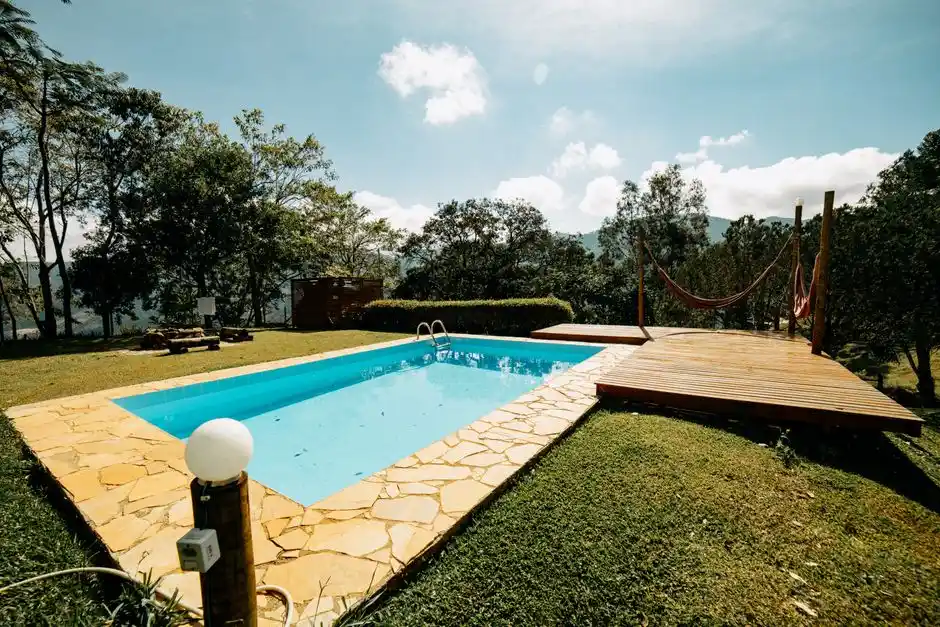
If your pool drops more than a quarter inch per day with the pump off, it is leaking - not evaporating. Houston's heat and humidity push normal evaporation to roughly 0.2 to 0.25 inches per day in summer, so anything faster than that, or any loss that continues overnight, points to a hole in the shell, a cracked line, or a failing fitting. This article walks you through the bucket test, the numbers that matter, and the signs that separate a real pool leak from routine water loss in Houston.
Pool leaking or evaporating Houston TX is one of the most common questions we field, and the answer almost always comes down to two measurements: how much water you lose per day, and whether you lose it with the pump running or off. Get those two numbers and you have your answer.
How much pool water loss is normal in Houston
Normal pool evaporation in Houston runs about 0.2 inches per day in spring and fall, 0.25 to 0.3 inches per day in July and August, and closer to 0.1 inches per day in December and January. That works out to roughly 2 to 3 inches per week at the peak of summer, which is why so many pool owners top off the water every few days and assume nothing is wrong.
Three things drive that rate up in our climate. First, surface area: a 500-square-foot pool loses water faster than a 300-square-foot one, all else equal. Second, wind - a breezy afternoon in the Heights or along the bay can double the evaporation rate for a few hours. Third, water temperature: a heated pool at 88°F evaporates noticeably faster than an unheated one sitting at 78°F.
What is not normal is losing water overnight with the pump off. Evaporation slows to a crawl when the sun is down and the air is cooler. If your water level drops half an inch between 10 p.m. and 6 a.m., that is a leak, full stop.
How do I know if my pool is leaking or evaporating in Houston TX?
You know it is a leak, not evaporation, when the loss exceeds a quarter inch per day, continues overnight, or shows up in one specific spot - a wet patch near the equipment pad, a sinking deck, or a waterline that drops to the same level every time. Evaporation is uniform and weather-driven. Leaks are stubborn and localized.
Here is the short version of the diagnostic we run on every pool:
- Mark the water level at the skimmer with a piece of tape or a grease pencil.
- Run the pump 24 hours and measure the drop.
- Top off, then run the pump off for another 24 hours and measure again.
- Compare the two numbers. If loss with the pump off is nearly the same as with it on, the leak is in the shell or a fitting. If loss is much worse with the pump on, the pressure side of the plumbing is the suspect.
That last distinction matters because it tells us where to look first. A pressure-side leak - return lines, booster pump fittings, a cracked eyeball - only leaks when water is being pushed through it. A suction-side leak pulls air instead of pushing water, so you will see bubbles in the pump basket and a pump that loses prime. A shell leak just sits there and drains.
The bucket test: the 24-hour answer
The bucket test for pool leak Houston homeowners run at home is the cheapest, fastest way to separate evaporation from a real leak. You need a five-gallon bucket, a brick or rock to weigh it down, and a marker.
- Fill the bucket about three-quarters full with pool water.
- Set it on the top step of the pool so the water inside the bucket sits at the same level as the pool water outside.
- Mark both water levels - inside the bucket and on the pool wall - with tape or a grease pencil.
- Run the pool normally for 24 hours.
- Measure the drop in both places.
If the pool drops about the same as the bucket, you are looking at evaporation. If the pool drops more than a quarter inch beyond the bucket over 24 hours, you have a leak. Repeat the test with the pump off to narrow down which side of the system is losing water.
One caveat: the bucket test works best when the pool is not being used, no autofill is running, and no rain falls during the test window. Houston weather being what it is, check the forecast before you start.
Signs of pool leak Houston TX homeowners keep missing
Signs of pool leak Houston TX homeowners overlook most often are the ones that show up away from the water - in the yard, on the deck, or on the water bill. Water always goes somewhere, and that somewhere usually leaves a mark.
Watch for these:
- A wet or spongy patch in the yard between the pool and the equipment pad, even when it has not rained.
- Sinking or cracking deck sections - soil washing out under the concrete is a classic underground leak symptom.
- Air bubbles in the pump basket or a pump that keeps losing prime, which points to a suction-side leak.
- Algae that keeps coming back in one corner or along one wall, because fresh water is diluting your chlorine in that spot.
- A water bill that jumps 2,000 to 5,000 gallons in a month with no change in household use.
- Loose tiles or a crumbling skimmer throat, which often means water is getting behind the shell.
- Persistent low water level that stops dropping at a specific point - usually the bottom of the skimmer or a light niche.
If you are seeing any of these alongside a fast water drop, it is time to stop guessing. Our team handles Pool Leak Detection Houston TX with pressure testing, dye testing, and electronic listening gear, and we can usually tell you where the leak is the same day.
It is also worth checking the rest of the house while you are at it. Pool water loss and slab moisture sometimes share a cause - a shifting soil line or a pressurized line that has finally given out. If you are seeing cracks in the patio or a warm spot on the floor inside, it is worth having Slab Leak Detection Houston TX done at the same time so you are not chasing the same problem twice.
Common mistakes when diagnosing pool water loss Houston Texas
Common mistakes when diagnosing pool water loss Houston Texas come down to skipping the measurement step and jumping straight to a conclusion. Here is what we see most often.
Assuming it is evaporation because it is hot. Houston summers are brutal, but a quarter inch per day is the ceiling for normal loss. If you are topping off every other day, that is not the sun.
Only testing with the pump running. The pump-on test tells you the total loss. The pump-off test tells you whether the pressure side is involved. You need both numbers.
Ignoring the autofill. If your pool has an autofill valve, it can mask a leak for months. Shut it off for 24 hours before you test, or you will never see the real number.
Patching the visible crack and calling it done. Water finds the path of least resistance. Sealing one crack while a fitting behind it is still weeping just moves the problem.
Waiting until the deck sinks. By the time concrete is moving, soil has been washing out for weeks. Earlier detection is cheaper, every time.
When to call a professional
Call a professional when the bucket test shows more than a quarter inch of excess loss per day, when you see the same wet patch in the yard two weeks in a row, or when the water level drops overnight with the pump off. Those three signals mean the leak is real and it is not going to seal itself.
We are Leak Detection The Heights, and we work pools across the Heights, Garden Oaks, Oak Forest, Memorial, and the surrounding neighborhoods. Our technicians use Electronic Leak Detection Houston TX gear - pressure rigs, listening discs, and dye testing - to pinpoint the leak before anyone starts digging. We find it, we fix it, and we re-test the line before we leave.
If your pool shares a wall with the house or sits close to the foundation, we also check the structure while we are on site. Water that leaves a pool does not always stay in the yard, and a slow leak under a slab can do real damage over a Houston summer. That is why we often pair pool work with Foundation Leak Detection Houston TX on properties where the pool and the house are within a few feet of each other.
Frequently Asked Questions
How do I know if my pool is leaking or evaporating in Houston TX?
Run the bucket test for 24 hours. If the pool drops more than a quarter inch beyond the bucket, it is leaking. Normal Houston evaporation is about 0.2 to 0.25 inches per day in summer and less in winter. Overnight loss with the pump off is almost always a leak.
How much water should my pool lose per day in Houston?
A pool in Houston should lose 0.2 to 0.3 inches per day in summer and 0.1 to 0.2 inches per day in winter. That is roughly 2 to 3 inches per week at the peak of summer. Anything faster, or any loss overnight, points to a leak.
Who fixes pool leaks in Houston Texas?
Leak Detection The Heights fixes pool leaks across Houston, including the Heights, Garden Oaks, and Memorial. We use pressure testing, electronic listening, and dye testing to locate the leak, then repair it and re-test the line before we leave. Call 832-839-4984 to schedule.
How much does pool leak detection cost in Houston TX?
Typical 2026 pricing for pool leak detection in Houston runs $350 to $650 for a standard residential pool, depending on size and how many areas need testing. Repairs are quoted separately once we know what we are dealing with. We give you the number before we start.
Can a pool leak fix itself?
No. A pool leak will not seal itself, and most get worse as water erodes the surrounding soil or shell. Small shell cracks can sometimes be patched, but line and fitting leaks need proper repair. Waiting usually costs more than fixing it early.
Get help with Leak Detection in Houston
If your pool is losing more than a quarter inch per day, or you are seeing wet spots in the yard that were not there last month, we can find the leak and stop it. Leak Detection The Heights serves pool owners across Houston with same-week scheduling and upfront pricing.
Call 832-839-4984 and we will get a technician out to run the tests, pinpoint the leak, and give you a straight answer on the repair.